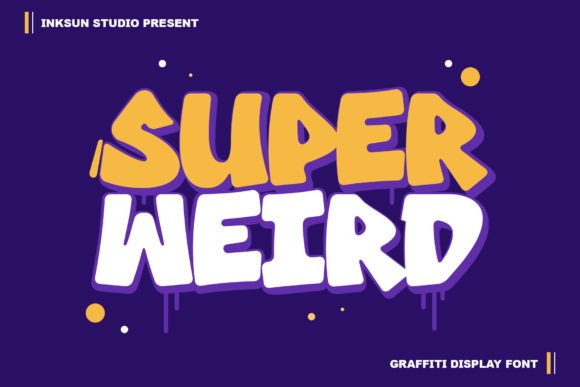
Super Weird Font: Bold Graffiti Display for Handmade Labels & SVG Designs
If you’ve ever held up a hand-poured candle, a boutique tote bag, or a wedding welcome board and thought, “This needs more attitude”—Super Weird is the display font that answers that call. It’s not just another edgy typeface; it’s a tightly crafted graffiti-inspired display font built for makers who want their physical products to spark curiosity, stand out on crowded shelves, and feel authentically *alive*. As someone who cuts vinyl for small-batch stickers, designs printable planner pages, and sources fonts for client packaging projects, I reach for Super Weird when I need boldness with intention—not chaos.
Visually, Super Weird balances raw energy with surprising legibility. Its letters have uneven baselines, playful distortions, and subtle spray-paint texture cues—but they’re carefully spaced and weighted so names, product titles, and short phrases stay crisp even at 24pt on a printed tag or scaled down for a 1.5-inch sticker. Unlike some graffiti fonts that sacrifice clarity for flair, Super Weird keeps its personality without becoming indecipherable. That makes it ideal for real-world craft use: think “Small Batch” stamped on a jam jar label, “Est. 2023” laser-cut into a farmhouse sign, or “You’re Invited” popping off a foil-embossed birthday card.
For Cricut and Silhouette users, Super Weird cuts cleanly—especially in its OTF format—because its outlines are smooth and well-hinted. I’ve used it for layered vinyl decals on mugs and tumblers, and it holds up beautifully when resized between 18–48pt. Just avoid pushing it below 14pt for physical labels (like tea bag tags or soap wrappers), where tight letterforms can blur during printing or cutting. On digital printables—think downloadable wall art PDFs or editable Canva templates—it shines at headline sizes (60–120pt) and adds instant urban charm to quote posters, motivational planner headers, or seasonal collections like “Spooky Season” or “Summer Vibes.”
Where Super Weird truly earns its place in your font library is in brand consistency across product lines. A small-batch candle shop might use it for scent names (“Midnight Graffiti,” “Neon Rain”) on front labels, then echo that same energy in Instagram story graphics and printable gift tags—all while keeping the rest of their identity clean and readable. It works especially well for limited-edition drops, pop-up markets, or streetwear-inspired stationery because it signals creativity *without* sacrificing professionalism. Customers don’t just see a font—they sense confidence, originality, and attention to detail.
Here’s how I use it across real projects:
- Candle & soap labels: Paired with a light sans serif (like Montserrat Light) for ingredients and weight info—Super Weird handles the scent name and brand logo lockup.
- Wedding stationery: Not for full invites, but perfect for “Welcome to Our Day” signage, cocktail napkin prints, or custom vinyl decals on acrylic cake stands.
- Digital printables: Used in editable PDF planner covers, printable quote art, and Canva-ready social media banners—always as the focal headline, never body text.
- SVG bundles: Included in my “Urban Wedding Bundle” and “Boutique Packaging Kit” because it scales flawlessly and reads clearly in both black-and-white cut files and color overlays.
- Seasonal crafts: “Naughty List” on holiday ornaments, “Sunset Sessions” on summer photo booth props, “Ghost Town” on Halloween yard signs.
Font pairing matters—and Super Weird plays surprisingly well with others. Try it with a relaxed handwritten font (like “Quicksand” or “Pacifico”) for contrast in greeting cards, or pair it with a sturdy, neutral sans serif (Inter, Lato, or even Helvetica Neue) for packaging where hierarchy and clarity are key. Avoid stacking it with other high-contrast display fonts—that’s visual noise, not harmony. And while Super Weird isn’t a serif font or script font, its expressive nature means it pairs best with typefaces that ground rather than compete.
Before downloading, check what’s included: most versions of Super Weird offer standard OpenType features—ligatures, stylistic alternates, and uppercase-only variants—so you can fine-tune “THE END” or “VINTAGE” for extra punch. It supports basic Latin characters and common punctuation, making it solid for English-language product labeling and digital downloads. If your shop sells internationally, verify multilingual support separately—but for Etsy, Shopify, and local craft fairs, it covers the essentials.
One practical note every maker should know: Super Weird is licensed for commercial use, meaning you can legally use it in physical products (stickers, mugs, apparel), digital templates, SVG files, and client work—as long as your license permits resale. Always double-check the vendor’s terms, especially if bundling it into editable Canva templates or selling font-based design assets. When in doubt, go with a reputable marketplace that clearly states extended commercial rights. This isn’t just about compliance—it’s about protecting your shop’s reputation and ensuring your customers get polished, professional results every time.
At its core, Super Weird isn’t just a display font—it’s a tool for storytelling. It tells people your brand doesn’t play it safe. That your handmade goods have soul. That your digital printables aren’t generic. Whether you’re laser-cutting a welcome sign for a coffee shop opening, designing printable wall art for Gen Z renters, or slapping bold lettering on a limited-run tote bag, this font gives your work an unmistakable voice. And in a market where attention is scarce and authenticity is currency, that voice? It’s worth every pixel.